
-
File Your Taxes
 Find a Location
File Your Taxes
-
Resolve Tax Issues
Resolve Tax Issues
Resolve Tax Issues
-
Tax Resources
See all Tax Help
Tax Tools
Tax Tips & Resources
-
 Log in | Sign up
JH Accounts


|
Oh no! We may not fully support the browser or device software you are using ! To experience our site in the best way possible, please update your browser or device software, or move over to another browser. |
Get up to $1,500 in minutes! Starting Dec. 10, come in for our Money Today Guarantee, if approved on a prepaid card. Terms apply.
IRS forms
Let us help you decode the most common IRS forms and publications that you may need when filing your taxes.
Education Forms

Things college students should know about Form 1098-T
Did you know that tuition payments can help reduce your tax? Learn everything you need to know about IRS Form 1098-T, including how to report qualifying education expenses, what the different boxes mean, and more.

Form 1099-Q: Payments from qualified education programs
Do you have a special account to save for college or other educational expenses? If so, you’ll probably receive IRS Form 1099-Q at some point. You don’t always have to include information from your 1099-Q on your tax return, and it doesn’t always affect how much you owe in taxes. Keep reading to learn what the form is for and how to use it.
Understanding Coverdell ESA Distributions and Form 5498-ESA
A Coverdell ESA is a higher education savings account that takes the form of a trust or custodial account originated in the United States, designed solely for paying the beneficiary's qualified education expenses in the future. When the account is created, it must be declared a Coverdell ESA for federal tax purposes.
Income Reporting Forms

IRS Forms W-2 vs. W-9: What's the difference & which form do you need?
Getting a W-2 instead of a W-9 (or vice versa) comes down to one thing: how you're classified as a worker. In this article, you’ll learn what each form is, who fills them out, the risks of being misclassified, and more.
All About Form 1099-MISC
Form 1099-MISC is used to report various types of miscellaneous income that are not reported on other Forms 1099. Many specific types of income often have their own forms in the 1099 series, such as the 1099-R for retirement income and 1099-INT for interest.

Form 1095-C: Employer-Provided Health Insurance Offer and Coverage
If you’re an employee of a company and opted into the company’s health insurance plans, chances are you’ve received a Form 1095-C. But what is this form, and what should you do if you receive it? We’ll break down what the various sections of the form mean, how to use it, and what the differences are between Forms 1095-A, 1095-B, and 1095-C.
Understanding Your Form 1099-B: Proceeds from Brokered and Bartered Transactions
What is IRS Form 1099-B? Learn about Form 1099-B and Proceeds from brokered and bartered transactions here.

Understanding form 1099-DIV: Dividend income
When you own stocks, mutual funds, or other investments, you might receive payments called dividends. These represent your share of the company’s investments, profits, or revenue. If you receive $10 or more in dividend income during a calendar year, you will receive IRS Form 1099-DIV. Here’s what the form is for, and how you use it.
Understanding Your Form 1099-G, Certain Government Payments
If you received payments from the federal or state government, these will be reported on your Form 1099-G. Read on to learn more about this form.

Understanding the 1099-NEC Form
By some estimates, there are over 41 million small businesses and gig-workers. It’s important to understand all the tax forms you might get if you are self-employed, including the 1099-NEC. So don’t miss this video!

Original issue discount and interest income on Form 1099-OID
Form 1099-OID is for taxpayers who received $10 or more in original issue discount (OID) from investments like bonds, notes, or Treasury securities lasting over a year. OID arises when the stated redemption price exceeds the issue price at maturity. Report it as taxable interest income on Schedule B or Line 2 of Form 1040.
Tax form 1099-R
Form 1099-R is part of the IRS Forms 1099 series and issued whenever you receive more than $10 in retirement income.
Understanding Your Form 1099-K
You received an IRS Form 1099-K? Congratulations. It usually means you have earned income for a small business or side gig you’re running. It can also complicate your taxes. Read on to learn why people receive this form, what it is used for, and what to do with it.
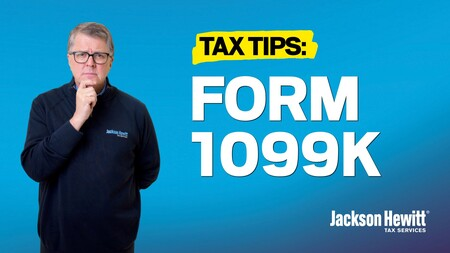
Form 1099-K: Tax Deductions and Tax Benefits 2024
There have been recent changes to who will receive a Form 1099-K, Payment Card and Third Party Network Transactions, for tax year 2025, which has led to some major confusion. You don’t want to miss this video where we share details about the changes, as well as what the 1099-K is, how it can be beneficial for taxpayers, and what happens if you don’t report self-employment income you’ve earned, and more.

IRS Form W-2: What is an IRS W-2 Form? – Jackson Hewitt
If you’re an employee, you’ll need your W-2 to file your taxes, and to get your refund! In this guide, we’ll cover everything you need to know about IRS Form W-2, including who receives it, what each box means, and what to do if you don’t get yours on time.

What is IRS Form 1099-SA? Distributions reported from an HSA, MSA
When you use the funds from a health savings account (HSA), or a medical savings account (MSA) you will receive Form 1099-SA to include the distributions in your federal taxes. Read more to find out more about HSAs and MSAs, how to file the correct forms, and how this may affect how much you pay—or owe--when tax time rolls around.

What is Form 4070 and why is it important?
If you work in the service industry for an employer, customers may tip you with extra money on top of your regular pay. IRS Form 4070 is a daily tip log that can help you keep track of your tips. Here’s what you need to know about reporting your tips on your tax return.
More Results
Individual Tax Return Forms
What You Need to Know About 1040 Tax Return Forms
A 1040 tax form is the main form for a tax return that gets filed with the IRS when you are a US citizen or resident with taxable income to report.

Form 1040-SR, tax return for seniors
If you or your spouse are over 65, you may be interested in knowing what a Form 1040-SR is. It is the tax return form for seniors with a larger print, easier-to-read version of Form 1040. Continue reading to find out what the differences between Form 1040 and Form 1040-SR are, what deductions are available to you, and more.
Do I Need to File Form 1040-ES to Pay My Estimated Taxes?
Many taxpayers ask us every year about IRS Form 1040-ES. What is it, and what does it have to do with quarterly tax payments? Here, we’ll break down the details, so you can learn whether you need to file Form 1040-ES.
What You Need to Know About 1040A Tax Return Forms
What is IRS Form 1040A? Learn the purpose of Form 1040A and what forms to use now that this form is no longer available.
Understanding Form 2210: Penalties for Underpayment of Estimated Taxes
What is IRS Form 2210? Learn about Form 2210 and Penalties for Underpayment of Estimated Taxes here.
Claiming the Foreign Earned Income Exclusion and Foreign Housing Deduction with Form 2555
What is IRS Form 2555? Learn the basics of Form 2555 and claiming the Foreign Earned Income Exclusion here.
How to Use Form 4852 as a Substitute for Missing Forms W-2 and 1099-R
What is IRS Form 4852? Learn about Form 4852 and substituting missing W-2s and 1099-Rs here.
Reporting Additional Taxes on IRAs and Other Tax-Advantaged Accounts on Form 5329
What is IRS Form 5329? Learn the basics of Form 5329 and reporting additional taxes on tax-advantaged accounts.
Determining Alternative Minimum Tax with Form 6251
Do you know what Alternative Minimum Tax is? It may actually be something that could affect your income tax. Read on to find out how.
Reporting Noncash Charitable Contributions on Form 8283
What is IRS Form 8283? Learn the basics of Form 8283 and reporting additional taxes on tax advantaged accounts.
Using Form 8332 to Release Your Child's Dependent Exemption to Noncustodial Parent
What is IRS Form 8332? Learn the basics of Form 8332 and releasing a child’s dependent exemption to a noncustodial parent.
Reporting Nondeductible IRAs on Form 8606
Are you contributing to a traditional or Roth IRA? You may need an IRS Form 8606. Learn more on this form and how to fill it out.
Filing a Change of Address with the IRS Using Form 8822
Have you recently moved and need to change your address with the IRS? Fill out a Form 8822. Read on to find out how.
Claiming the Saver’s Credit for Retirement and ABLE Account Contributions with Form 8880
What is IRS Form 8880? Learn about Form 8880 and claiming the Saver’s Credit for Retirement and ABLE account contributions.

Form W-10: Dependent Care Provider's Identification and Certification
Do you pay someone to take care of a child or dependent so you can work, look for a job, or go to school? Good news: you might be eligible for a tax credit that can boost your refund. Read on to find out how Form W-10 can help.

Report additional income and adjustments on Schedule 1
When it comes to dealing with taxes, understanding the forms is crucial, and one form you'll encounter is Schedule 1. It came into the scene after changes in 2018 that got rid of Forms 1040A and 1040-EZ. Schedule 1 is now essential for reporting specific types of income and deductions known as adjustments. While regular income goes on the main page of Form 1040, Schedule 1 is where you report "extra income" and certain deductions.
Understanding Itemized Deductions on Schedule A (Form 1040)
What are the specific things you can deduct on your tax return? Read on to learn more about Schedule A of Form 1040 and these items.

Reporting interest and dividend income on Schedule B
Do you earn interest from a bank account or other investments? Do you get paid dividends from stocks or other investments you own, or have financial accounts in another country? If so, read on to find out if you need to file Schedule B with your tax return, and how to use this important form.

Schedule K-1: What Is It and Who Is It for?
If you are a shareholder in an S corporation, partner in a business partnership, or beneficiary of an estate or trust, you will receive a Schedule K-1 form. The form is used to pass the income from the business or estate through to the investor or beneficiary so they can file an accurate tax return. Below, we break down the three types of K-1 forms and how to use the information they provide.

What Are IRS FBAR Filing Requirements?
If you have $10,000 or more invested in a total of all foreign accounts or estates, and you are required to file a US tax return, you must file the Report of Foreign Bank and Financial Accounts (FBAR) annually.
More Results
IRS Resolution Forms
What You Need to Know About Form 2848, Power of Attorney with the IRS
Form 2848 is filed with the IRS when you wish to grant someone Power of Attorney (POA) with respect to your federal tax matters.

Form 8857: Request for innocent spouse relief
If your spouse or former spouse filed a joint tax return and made a mistake, you might owe more money in taxes. With Form 8857, you can explain to the IRS why you are not responsible for the errors and are entitled to relief. Keep reading to learn how it works.
IRS Installment Agreements Using Form 9465
Form 9465 is used to request an installment agreement with the IRS when you can’t pay your tax bill when due and need more time to pay.
Self-Employment Forms
How to Deduct Depreciation and Amortization on Form 4562
What is IRS Form 4562? Learn the basics of Form 4562 and deducting depreciation and amortization.

Calculate self-employment tax with Schedule SE
Did you receive a Schedule SE? Learn more about calculating self-employment tax with the Schedule SE form, here
What is Form SS-4?
If you need an employer identification number (EIN), you need to file Form SS-4 or complete the IRS’ online application, where individuals or businesses could receive this number in minutes.
Individual Tax Return Forms

IRS Transcript: How Do I Request One?
Have questions about IRS tax transcripts? Keep reading to learn what tax transcripts are, how they differ from returns, when you may need a transcript, how to get a transcript, what common codes mean, and more.
Because trust, guarantees, convenience & money all matter


Get your biggest tax refund & much more!
Sign up and be one of the first to access our exclusive promotions and get tax tips that will maximize your money.
We'll only send you the best deals and helpful tips, and we'll never share your email with others. See our Privacy Policy and Terms of Service for more information.

Almost done!
Enter your mobile phone number to get exclusive savings on trusted tax prep, IRS deadline reminders, and more.
We’ll only text you with deals and tax tips to maximize your money. You
can opt out at any time.
By providing your phone number and clicking “Submit,” you agree to receive recurring
marketing and informational calls and texts (including those made using an automatic
telephone dialing system or prerecorded voice) from Jackson Hewitt at the number you
provided. Consent is not a condition of purchase. Message and data rates may apply. Text
STOP to opt out. See our Privacy Policy and Terms of Service for more information.

Thanks for subscribing!
Ready to meet a Tax Pro and maximize your refund money? Book an appointment now.

Your nearest locations
The Money Today Guarantee is only available to clients who (i) are approved for an Early Tax Refund Advance loan; and (ii) elect and are eligible to receive loan funds on a prepaid card. Loan available during hours of operation. Hours vary by location. Loan application must be submitted by 11pm local time. If funds are not credited to your card before 12am local time, Jackson Hewitt will credit $50 within 2 weeks to your card if available or provide you a $50 eGift card. Fees, terms, and conditions apply to the prepaid card.
The Early Tax Refund Advance (ETRA) is a loan secured by, and paid back with, your tax refund and is offered by First Century Bank, N.A. Loan amounts are determined by your expected federal refund, less authorized fees and underwriting. Loan amounts are $300, $500, $1,000, and $1,500. To be eligible for the $1,500 ETRA loan, your expected federal refund, less authorized fees, must be at least $5,000. Most common ETRA loan amount approved is $300. ETRA loan is subject to underwriting and approval. Loan proceeds are typically available on the same day of approval, if disbursed on a prepaid card offered at Jackson Hewitt offices, or in 1-5 business days with direct deposit. Terms and restrictions apply. For details visit jacksonhewitt.com/loans. Jackson Hewitt is a Rhode Island Licensed Loan Broker and holds other relevant licenses for the locations where this product is offered. If approved, a finance charge applies except for residents of CT and NE.
Money Today Guarantee
The Money Today Guarantee is only available to clients who (i) are approved for a refund advance loan; and (ii) elect and are eligible to receive loan funds on a prepaid card. Loan available during hours of operation. Hours vary by location. Loan application must be submitted by 11pm local time. If funds are not credited to your card before 12am local time, Jackson Hewitt will credit $50 within 2 weeks to your card if available or provide you a $50 eGift card. Fees, terms, and conditions apply to the prepaid card.
Early Tax Refund Advance
The Early Tax Refund Advance (ETRA) is a loan secured by, and paid back with, your tax refund and is offered by First Century Bank, N.A. Loan amounts are determined by your expected federal refund, less authorized fees and underwriting. Loan amounts are $300, $500, $1,000, and $1,500. To be eligible for the $1,500 ETRA loan, your expected federal refund, less authorized fees, must be at least $5,000. Most common ETRA loan amount approved is $300. ETRA loan is subject to underwriting and approval. Loan proceeds are typically available on the same day of approval, if disbursed on a prepaid card offered at Jackson Hewitt offices, or in 1-5 business days with direct deposit. Terms and restrictions apply. For details visit jacksonhewitt.com/loans. Jackson Hewitt is a Rhode Island Licensed Loan Broker and holds other relevant licenses for the locations where this product is offered. If approved, a finance charge applies except for residents of CT and NE.