






MIN READ
Your biggest tax refund, guaranteed!
We'll maximize your refund, or we pay you $100. Terms apply.
Find a locationKey takeaways
- A health savings account (HSA) is a tax-exempt account that stays with you for life and covers qualified medical expenses.
- Eligibility depends on having a high-deductible health plan (HDHP) and no disqualifying additional coverage.
- HSA contributions are tax deductible, even if you take the standard deduction.
- For 2026, individuals can contribute up to $4,400 and families up to $8,750, with a $1,000 catch-up for those 55 and older.
- You can use your HSA funds for a wide range of medical, dental, vision, and mental health expenses.
- Any non-medical withdrawals you make before age 65 trigger a 20% penalty plus income tax. If you’re 65 and older, you avoid the penalty but still owe income tax.
- Report your HSA contributions on Form 8889 and file it with your Form 1040 or 1040NR.
- You keep your HSA even if you change jobs, though you must have an HDHP to continue contributing.
- Compared to an FSA, an HSA offers more flexibility, higher limits, and no "use it or lose it" deadline.
Health savings accounts (HSAs) offer some of the biggest tax perks available to eligible taxpayers. Keep reading to learn how HSA contribution limits, deductions, and withdrawal rules work for 2026.
What is a health savings account (HSA)?
A health savings account (HSA) is a tax-exempt account you can use to pay or reimburse yourself for qualified medical expenses.
Your contributions to an HSA grow tax free, and the account stays with you, even if you change employers or leave the workforce. Unused funds carry over to the next year, and there is no time limit on when you can use them.
Who qualifies for an HSA?
You may qualify for an HSA if:
- You are covered by a high-deductible health plan (HDHP) on the first day of the month (HDHP eligibility includes telehealth outside the HDHP deductible, Marketplace bronze and catastrophic plans and Direct Primary Care Service arrangements, in addition to traditional HDHPs)
- You have no other health coverage except worker’s compensation, insurance for a specific disease or illness, or a fixed amount of coverage per day for hospitalization
- You are not enrolled in Medicare (any Part)
- You are not claimed as a dependent on someone else’s tax return
One important thing to note: There is no such thing as a joint HSA for married couples. Instead, each person must qualify on their own and have their own account. If both spouses have family HDHP coverage, the $8,750 family limit is split between the two HSAs.
Are HSA contributions tax deductible?
Yes, your contributions to an HSA are tax deductible, even if you choose to take the standard deduction instead of itemizing. Additionally, your employer’s contributions are pre-tax and excluded from your gross income.
HSA contribution limits for 2026
The maximum contribution amounts for 2026 are $4,400 for individuals and $8,750 for families. If you are 55 or older, you can make an additional catch-up contribution of up to $1,000.
What can you pay for with HSA funds?
You can use your HSA funds to pay for many kinds of medical expenses, including:
- Doctor’s visits, lab fees, hospital care, etc.
- Prescription medications
- Over-the-counter medications
- First aid supplies, like bandages, antibiotic ointment, etc.
- Menstrual care products, like pads and tampons, heating pads, etc.
- Pregnancy tests and over-the-counter aids, like orthopedic pillows, prenatal vitamins, etc.
- Medical equipment, like crutches, hearing aids, blood glucose monitors, etc.
- Air purifiers and humidifiers used to treat specific conditions, with a Letter of Medical Necessity (LMN) from your provider
- Supplements with proven therapeutic purposes, like glucosamine for joint pain or fiber for laxative support
- Supplements used to treat or prevent medical concerns, like high-dose Vitamin D or probiotics, with an LMN from your provider
- Dental cleanings, examinations, fillings, braces, etc.
- Therapy and counseling for mental health
- Eye examinations, contact lenses, prescription glasses and sunglasses, etc.
- Chiropractic care, such as spinal adjustments and diagnostic services, for treatment of a medical issue (not for general well-being)
- Physical therapy prescribed by your provider
- And more
What happens if you withdraw HSA funds for non-medical expenses?
If you are younger than 65, any HSA funds you use for non-medical expenses will come with a 20% penalty, plus your ordinary income tax. If you are 65 or older, the 20% penalty doesn’t apply, but your funds are still taxed as regular income.
How to claim the HSA tax deduction: Form 8889
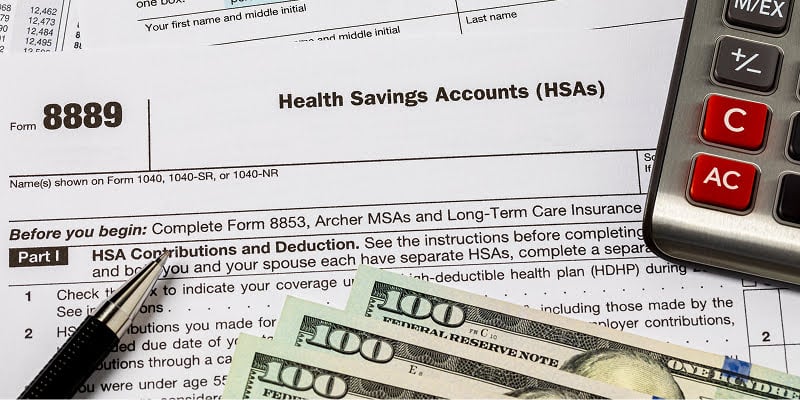
You report tax-deductible HSA contributions on Form 8889, Health Savings Accounts (HSAs), and file it with your Form 1040 or Form 1040-NR.
Can you keep an HSA if you change jobs?
Yes, you can keep your HSA if you change jobs. Even if your HSA funds solely come from employer contributions, your HSA is your account, and there’s no deadline to use your funds. However, you can only continue to contribute to your HSA if you still qualify, which means you must have an HSA-eligible HDHP.
How does an HSA compare with an FSA?
| HSA | FSA | |
|---|---|---|
| Ownership | You own it and keep it when you leave your job or retire. | Your employer owns it, and you forfeit it when you leave your job or retire. |
| Eligibility requirements | You must be enrolled in an HDHP to qualify. | You may qualify with any type of employer health plan. |
| Rollover | You have unlimited rollovers. | Your funds are mostly “use it or lose it,” though employers may choose to offer a small carryover or grace period. |
| Contribution limits for 2026 | You can contribute up to $4,400 for an individual account, and up to $8,750 for a family account. If you’re 55 or older, you can contribute up to $1,000 more. | You can contribute up to $3,400. |
| Tax treatment | Your contributions, growth, and withdrawals for qualified medical expenses are all tax free. If you’re younger than 65, non-qualified withdrawals are taxed at your regular rate and have a 20% penalty. | Your contributions and withdrawals for qualified medical expenses are tax free. |
| Investment options | In many cases, you can invest your balance once it meets a certain threshold. | You cannot invest your balance. |
| For taxpayers 65 and older | You can use your funds for any reason without the 20% penalty (non-medical expenses will be taxed as income). | There are no special provisions for people 65 and older. |
| Account management | You manage your account. | Your employer’s vendor manages your account. |
Have questions or concerns about how your HSA contributions or withdrawals impact your taxes? Reach out to your local Tax Pro. We’re open all year and ready to help. Find tax services near you, then walk in or book now.


About the Author
Sharon Brucker is a Senior Tax Research Analyst at Jackson Hewitt Tax Services who specializes in consumer income tax and estate and trust issues. A Certified Public Accountant (CPA) with a Master of Business Administration (MBA) and more than 35 years of experience, Sharon helps to ensure that the most current IRS tax information is distributed throughout Jackson Hewitt and its franchisees. She also simplifies complex tax laws for Tax Pros and clients alike.
*This content is for general informational purposes only. It is not intended to be comprehensive and should not be construed as professional tax or financial advice for any specific individual tax situation. Taxpayers should always consult a qualified professional for individual guidance. This information constitutes a solicitation under the Treasury Department's Circular 230. Most offices are independently owned and operated.
